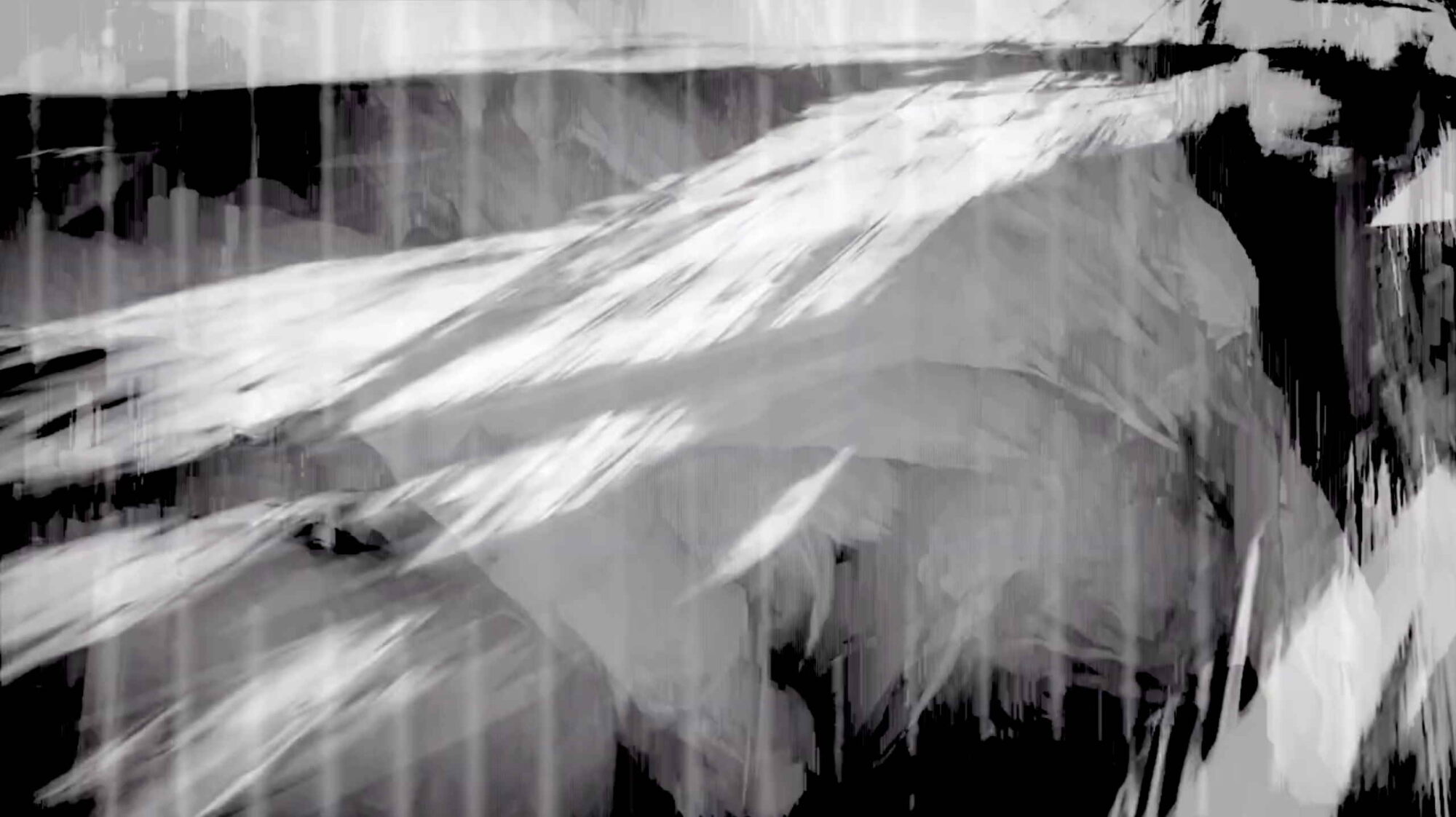
segment 19 – FLUME – a post-cinematic a/v composition for video, accordions, sine tone and tube. Originated in a commissioned composition for Flow. Flow is a project by Dr Martina Cecchetto, with the scientific contribution of Dr Florian Betz and the artistic curation of Riccardo Fumagalli, in collaboration with Cities & Memory, the University of Padua (Italy), and the University of Würzburg (Germany).
– segment 19 – FLUME audio composition was premiered at the EGU26 general assembly geo-science congress in Vienna, Austria, 3–8 May 2026
– segment 19 – FLUME audio-visual composition live iteration was premiered at Klangzeit-Werkstatt festival by Gesellschaft für Neue Musik / GNM Münster at music-conservatory Münster, GER, May 16th 2026
Segment 19 – FLUME investigates the acoustic behavior of a regulated river segment through a post-cinematic audiovisual compositional approach. The piece originates from a field recording made inside the concrete tube of a fish pass, where water striking the walls produces a narrow resonance between A and B♭. This unstable microtonal field becomes the structural centre of the work. Granular and spectral processes, sine tones, and slowly drifting accordion drones performed on two slightly detuned instruments reorganise the recording into an evolving acoustic space. The video has its origins in massively processed false-color satellite images of the area. The aim was to transform the wide view from space into the way from the river basin through the narrow concrete tube under this dammed part of the river Lech near the municipality of Scheuring / GER. Rather than depicting the site, this video-composition amplifies its latent resonances, pressure, and spatial constraints. Segment 19 – FLUME also exists in a live iteration, where a third accordion performs live alongside the fixed video-composition to increase density and pressure.
More about the acoustic compositional approach of „segment 19 – FLUME“ @ Flowcast, the podcast companion to Flow by Riccardo Fumagalli, curator of FLOW project:
https://artmusicscience.substack.com/p/anja-kreysing-segment-19-flume soundtrack
„Anja Kreysing is a musician and researcher based in Münster, Germany. Her work moves between experimental music, sound art, and acoustic ecology, with a particular interest in how constructed and natural environments shape each other through sound.
For Flow, she worked on Segment 19 of the River Lech — a channelised, heavily regulated stretch near Sheuring, where dams and reservoirs for hydropower production have left the river, in the scientists’ words, “widely lacking natural geomorphic dynamics.” There are no restoration plans for this segment.
But Anja found a fish passage. A modest, largely unremarkable structure — a channel carved into concrete, built under a road — designed to recreate, as faithfully as possible, conditions natural enough for fish to navigate past a dam. When she recorded inside it, she found the water produced a very particular resonance: a narrow, unstable microtonal field sitting between the pitches A and B-flat.
That resonance became the starting point for everything.“
More about FLOW project by Cities and Memory, Universities Würzburg & Padova:
https://citiesandmemory.com/flow/
„Flow is a creative exploration of the river Lech, telling the story of a river through sound Past, present, and future flow together as artists transform field recordings, research and satellite images into a recomposed interpretation of the life of a river. The river’s story, reimagined in sound. The project is a collaboration between the University of Padova and the University of Würzburg, with support from Cities and Memory. Explore the recomposed sounds of the river Lech from its source to its end, as imagined by artists from all over the world – follow the course of the river on the sound map below. In each case, you can hear a field recording from that section of the river, and an artist’s (or multiple artists’) composition from the same section.
Flow is a project by Dr Martina Cecchetto, with the scientific contribution of Dr Florian Betz and the artistic curation of Riccardo Fumagalli, in collaboration with Cities & Memory, the University of Padua (Italy), and the University of Würzburg (Germany).“